Showing posts with label Learning. Show all posts

7.13.2014

The Maker Movement & "Real" Learning

Throughout this summer, I have been delightedly reading twitter posts sharing all of the making that is going on in the county, either through summer school programs, Coder Dojo, or the Summer Fine Arts Academy.  It warms my heart to see the kids who are genuinely interested and excited about architectural structures made from cardboard, illuminated headbands or notebooks drawings charged with lights and circuitry, and cool background designs coded on the computer.  The kids in the pictures are truly happy!  But lately I have been starting to wonder if all kids would enjoy this type of learning through making.

My older son will have a chance to join in this maker movement next week as he participates in a 3D printing class offered through the county's Coder Dojo Summer Academy.  He is excited to soak in all of the learning that will be offered.  Furthermore, last year, he thoroughly enjoyed the time he spent at Coder Dojo Academy learning Scratch and a "sampler" of coding programs.  Each day when I picked him up during those two weeks, he couldn't wait to tell me about what he learned and created on the computer.  I had also enrolled my younger son in the same classes, however, he did not share the same enthusiasm as his bigger brother.  He was utterly bored and begged me not to go after the first week was over.

My younger son is not intrigued by computers or coding.  He is lackadaisical about making things out of cardboard or other random materials.  If he has to, he will - as he did for his 3rd grade "Trashion Show" - and will have fun with it, but it does not kindle a fire in his learning soul.  Likewise, he has knowledge of and will use a computer to create, but if given a choice, he would quickly choose something he deems "real-life."

While other 3rd graders are engulfed in the Harry Potter series and other fantasy fiction, my son is immersed in reality.  He pours over his horse encyclopedia, which is filled with post-it notes and dog-eared pages.  He shuns the fiction on the shelves of Barnes and Noble and eagerly grabs the non-fiction books about animals and farming.  Furthermore, you are more apt to find him studying farming supply magazines or cattle auction fliers than getting lost in the latest Newbery Award novel - something as an English teacher and Reading Specialist, I am constantly trying to entice him to do.  His 3rd grade teacher shared with me that after he took his SOL tests, he spent his quiet time reading the John Deere catalogues she had collected to fuel his farming passions.


So how does my youngest son "make" in the real world?

He makes gardens and tends them meticulously, keeping them healthy by weeding and watering when there has been no rain.  He creates an enterprising produce stand in our community to sell what he grew.  He builds relationships.  This is his strength.  The young children in the community swarm to his stand to help him sell produce.  Many neighbors bring extra veggies from their gardens and donate them to him to sell at his stand.  He strengthens a community.  His small produce stand has brought individuals in the area out of their houses and cars to talk to each other at the stand.  Drivers, who once sped by without waving, now slow down and stop to chat and check out what is new in the garden.


The cool thing about this garden enterprise is the tremendous learning that is happening.  Science, math, writing and reading have all been incorporated.  Furthermore, there is more than one life-long learner competency involved - from pricing his produce to determining the best time and day to open his stand to understanding his customers.  This is REAL for him.  And because it is authentic, he cares.

So, it has made me wonder...how do we keep it real for him - and kids like him - when he returns to school mid-August?

You see, my son is not alone.  In his 3rd grade class, there are at least four other boys who share his agricultural passion.   They tend ponies and horses.  They understand landscaping and nurseries.  They take care of lambs and chicks and calves after they are born. They cultivate hay in the Spring and the Fall when the long grass is at its peak for nutrients.  They raise and sell cows, goats, sheep, and chickens - and have come to understand that owning "live" stock is just as lucrative (or maybe more) as owning "paper" stock.


But these young minds are not the first to understand this.  In addition to many horse farms, we share our community with the agricultural entrepreneurs and owners of Free Union Grass Farm, Shady Lane Farm, Timbercreek Farm, Grelen Nursery and Potter's Craft Cider.


I know that there are many computer applications that have been created through coding to help farms run successfully. However, I think the real focus for the owners of these local farms and businesses is on the science, math, and art encompassed in agriculture.  It is also on the making, building, and maintaining of relationships.

As teachers and administrators, let's not forget about the children who desire to follow in these business' agricultural footsteps.  I wonder what it would look like if the county had a Summer Farming and Agricultural Academy?  I wonder how many more children besides these five 3rd grade boys would love to attend?  I wonder how excited they would be about making on a farm?


4.04.2014

Getting Started with Google in Your Classroom

So, a few weeks ago, a couple of coaches and I sat down and threw together this little blog post that was published by The Center for the Collaborative Classroom. Our inspiration for the post were all of the great teachers out there who are curious about using Google in their classrooms, but need a few stepping stones to get started. Just click on the link below...Enjoy!

Getting Started With Google


PS...We collaborated using a Google Doc and simultaneously wrote the post from three different school locations we were each working in that day!

9.13.2013

Is Failure Really Success?

Last year, I had the opportunity to attend a Ridley Lecture at UVA and hear Carol Dweck, Stanford University professor of psychology and Mindset author, speak.  In addition to discussing the concept of growth vs. fixed mindsets, she made a statement that has stuck in the back of my mind: What would it look like if kids embraced the word "yet?"  It is such a small word, but so powerful and full of possibilities!  She talks about the word in the video below:


I work around many students who are paralyzed by perfectionism and by being the best.  They believe they have failed if they receive a grade lower than an "A" on their first attempt.  Furthermore, many throw their hands in the air and give up after that first try or if they are struggling.  How do we help children find opportunity in their perceived failure or struggle?  How do we help children realize that their struggle is really not necessarily negative? Rather, it is a learning opportunity, a chance to try again and gain deeper insight.  How do we help them develop the mindset of not being there "yet" and being totally cool with that?  How do we help children positively embrace the potential of failure like Audri Clemmons did when he tested his Rube Goldberg Monster Catcher:

Embracing Failure with Extreme Excitement - Audri's Rube Goldberg Monster Catcher


I have started collecting quotes that reflect this growth mindset.  Hopefully, they are small reminders to help students realize they are simply not there. . .YET!  And the struggle with getting there is totally worth it.


"I have not failed.  I've just found 10,000 ways that won't work."
- Thomas A. Edison

"You never fail until you stop trying."
- Albert Einstein

"Our greatest glory is not in never failing, but in rising up every time we fail."
- Ralph Waldo Emerson

"It is impossible to live without failing at something, unless you live so cautiously that you might was well not have lived at all - in which case, you fail by default."
- J.K. Rowling

"Only those who dare to fail greatly can ever achieve greatly."
- Robert F. Kennedy

"Success is stumbling from failure to failure with no loss of enthusiasm."
- Winston Churchill


8.22.2013

Words of Inspiration

Throughout the past months, I have come across some wonderful TED Talks and You Tube videos that have either made me reflect on my teaching practices or want to immediately jump into action. Here are a few of my absolute favorites...enjoy!

Embracing Failure with Extreme Excitement - Audri's Rube Goldberg Monster Catcher


The Power of Introverts - Don't forget about them in your classroom!


Every Kid Needs a Champion - Especially one who sees the value of "plus 2" in life!


Sir Ken Robinson - Bring on the learning revolution!


8.11.2013

The Most Wonderful Time of the Year

Do you know that back-to-school commercial where the dad is dancing and skipping through the office supply store, sprinkling school supplies in his cart as his children follow morosely behind?


I always giggle when I see it - every single time!  As a parent, I know so many parents who identify with the father in the commercial and his excitement for the start of the school year.  But, as a teacher, I am as giddy as the father in the commercial!  It truly is "the most wonderful time of the year!"  I love back-to-school shopping with my kids, but mostly, I love this time of the year because it is a fresh start after re-charging during the summer.  I was also able to re-charge, ironically, by working this summer!  I worked with many awesome teachers who spent their summer honing their practice...even during vacation!  Below is a recap of some of our work:

June

My summer started in June in Stillwater, MN, where I attended and presented at the 6th annual Flipped Learning Conference (FlipCon13) with an amazing chemistry teacher from Albemarle County Public Schools (ACPS).  The conference was electrifying and we had the privilege of meeting educators from all over the world, who came together (in this small town that I had never heard of) to share and discuss their best practices and ideas.  Every educator there had a sole focus - they were searching for the best way to engage, excite, and ignite their students' passion for learning.  Jon Bergman, Ramsey Musallem, Katie Lanier, and April Gudenrath are just a few of the phenomenal teachers we got to meet and pick their brains about their experiences with flipped teaching.

July

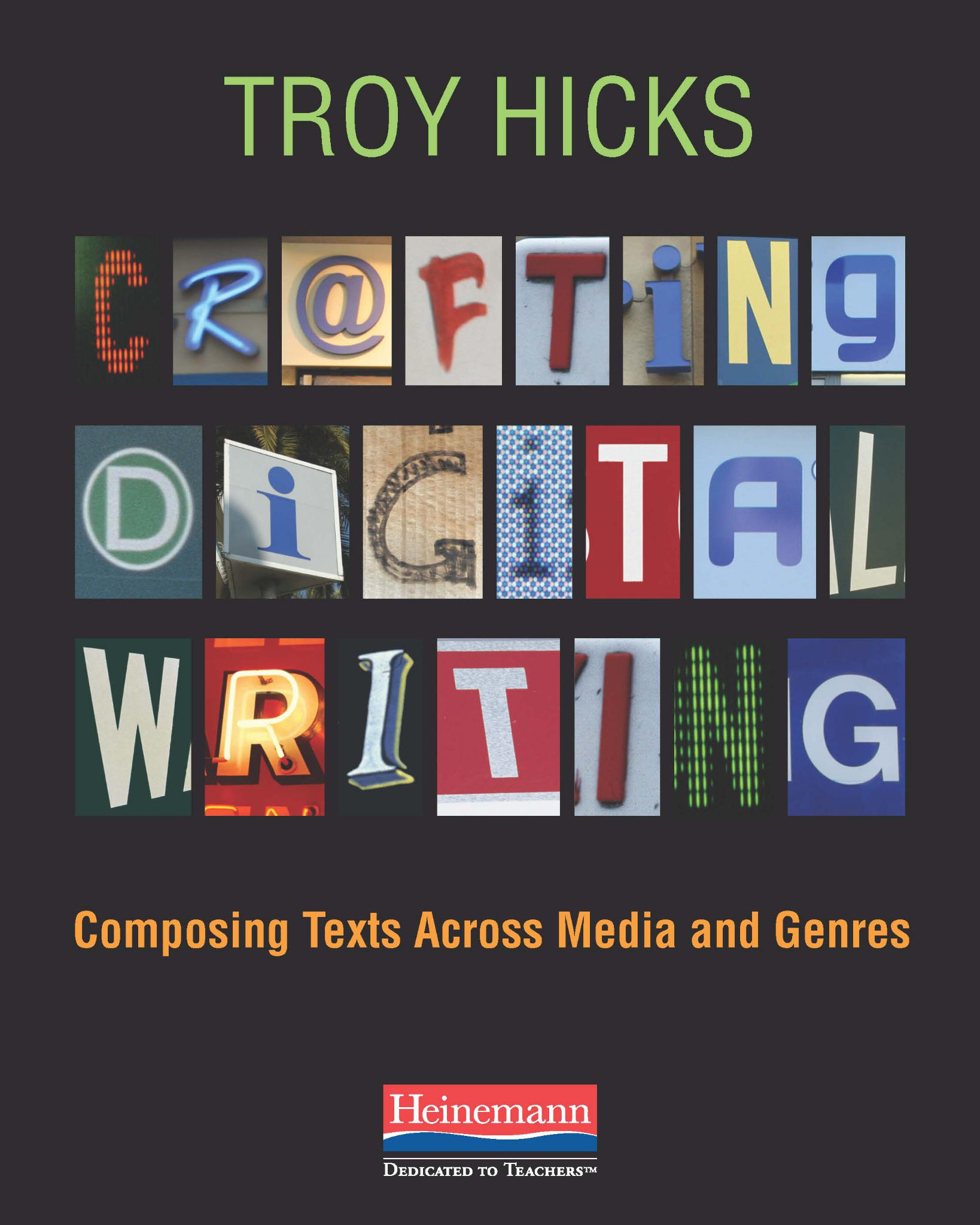
In July, three colleagues passionate about writing and I initiated a book study with teachers interested in Crafting Digital Writing.  Teachers from across the county took time from their summer to meet on three different occasions share their writing practices, look at different writing perspectives, and collaborate to build a digital writing lesson.  We were fortunate to be able to gather ideas from the author of the book, Troy Hicks, both through a live webinar and in person when he visited the county.  I am excited for our next book club meeting in September.


Also, I talked about teaching, learning, and classroom (and library) spaces with the teachers in my Twitter professional learning network (PLN).  We threw teaching ideas and book suggestions at each other.  We read books together.  We reported back to each other.  We shared excitement for each other's plans and spaces for their new school year.  This was one of my favorites because we were so excited the author got in on our conversation too!


August

During the first week in August, I had the opportunity to hang out with teachers new to ACPS.  Let me tell you, I had so much fun! The enthusiasm and energy abounding was contagious.  Everywhere I looked, teachers were laughing, collaborating, and opening themselves to new opportunities like creating a PLN by using Twitter (as introduced to them by our Superintendent).  Throughout the two days of New Teacher Academy, teachers got to know each other and ACPS's mission, goals, and priorities through interactive and highly engaging activities, which I am sure will be passed on to the students they work with this year.


Additionally, the 24 ACPS Instructional Coaches and 7 Lead Instructional Coaches gathered to plan for our work this year in the 26 elementary, middle, and high schools we support.  What fun time we had! Some highlights were creating a metaphor of our coaching practice by making with legos, pipe cleaners and cotton balls, as well as rallying our passion for a common text.  As a group, we will be reading and discussing throughout the year The Art of Coaching by Elena Aguilar.  I cannot wait to delve into this book and into the conversations we have as team of coaches.


After all of these summer experiences, I am so geared up and ready for the start of a brand new school year.  Not only do I have my Moleskine journal and a surplus of my favorite colored Sharpie pens ready, but I also have the numerous ideas, which came from many conversations with teachers far and near, tucked away to bring to school with me this year. I cannot wait for the adventures this school year will bring!  This truly is the most wonderful time of the year!

7.16.2013

The Power of Questions and Feelings of Discomfort

“Discomfort brings engagement and change. Discomfort means you're doing something that others were unlikely to do, because they're hiding out in the comfortable zone. ” 


I have two boys, one a rising 3rd grader and the other a rising 5th grader. Because we live in the country, their school bus arrives promptly to pick them up before the rooster crows.  For this reason, I have driven them to school every day since Kindergarten so we can leave after the sun has risen. However, I think the real reason I chose to drive them to school was a little more selfish on my part - I just wanted to spend a little more time with them.  I imagined a charming ride conversing about their hopes, dreams, and wishes in life.  In reality, our car ride has been comprised of 15 minutes of intricate questions posed by my boys - questions ranging from how to raise a pig or string a lacrosse stick to the thickness of the electrical lines or the inner workings of a generator.   Questions that I do not know how to answer because they are topics that simply are not on my radar.  By the time I arrive at their school, I find that I am so flustered and uncomfortable by their barrage of questions, as well as my ineptness in answering them, that I have erased all desires for our special time together.  Instead, I am filled with joy when I unload my boys in front of their school in the capable hands of the librarian, the perfect person to answer their questions!

I am an Instructional Coach for Albemarle County Public Schools.  Prior to this, I wore many hats.  I was a special education case manager, a reading specialist, a transition specialist, and a collaborative English teacher.  This past Spring, I was asked by a teacher, who did not know me in my previous life, what my expertise was.   Our County's coaching model assumes that Instructional Coaches are generalists not specialists, embedded professional development for teachers as they focus on the process of teaching.  As I fumbled for words to find an answer for this teacher, my county's Director of K-12 Education calmly jumped in and said, "Her expertise is questioning.  The Instructional Coaches are experts in asking questions."  Wow! Such a succinct answer, but such a true answer.  I have never thought of myself as an expert in questioning, but it is something that I now do every day when I am working with teachers.

When I first embarked on my career as an instructional coach, I balked at the questioning stems provided to me for my conversations with teachers.  What was the big deal about these question stems? As a veteran teacher, I comfortably spoke and collaborated with teachers, thought I had all of the answers, and prided myself in being able to provide a menu of options to them.  What I realize now is that using these question stems initially made me feel very uncomfortable because they were something new to me - they were not in the realm of my comfort zone.  However, they came to grow on me. Lately, instead of just talking to teachers, I find I have been asking tons of meddlesome questions - just like my boys! The teachers with whom I work have me constantly wondering with genuine curiosity. It isn't until now, as I start on my fourth year of coaching, that I realize the power of asking these questions to teachers.  They are questions that sit with teachers and gnaw at them late at night. Questions that drive inquiry, bring a nagging discomfort, and result in a nudge leading to an adventure in a whole new world. 

This past year, a teacher lamented to me about grading the papers for all of her 140 students.  I didn't empathize or commiserate.  Instead, I found myself wondering aloud to her  about the possibility of "flipping" feedback to all those students using screen casting technologies. I did this using my "I wonder what would happen if..." questioning stem without thinking - it just naturally burst out of my mouth.  I will never forget the look this teacher gave me -  a look like I had just landed from Mars and had three heads.  She quickly and emphatically exclaimed, "No way!"  And with that one question, she ditched me as expeditiously as I unloaded my boys from my car.  A week later, that same teacher sought me out and thanked me for my question.  She had tinkered with the technology and found a way to provide more meaningful feedback to her students.  This year, she is embarking on creating a digital writing workshop in her classroom.  Another teacher recounted the events of her new blended teaching practices in a presentation to the school board stating, "It all started with one question from an Instructional Coach."

Although, I only asked simple questions, these two teachers embraced them and wrestled with them.   They allowed themselves to reflect, to be nudged and to be irritated by a question, which ultimately has led them on new adventures in their educational careers.  Furthermore, they brought me along on their wonderful and wild ride.  It is on these adventures that I have learned so much from and been in awe of each teacher's ability to allow themselves to be uncomfortable, really uncomfortable.  It takes great strength to do this. These teachers are now leaders in their school, the county, and their wider professional learning network. They are not only facilitating meaningful learning with their students, but also their colleagues.

So, maybe questions aren't so bad after all.  Even my boys' simple questions about farm animals, sports equipment, and machines have been a blessing.  Inevitably, at some point in my day, I find myself googling "raising pigs" or whatever their inquiry of the day is.  I google because curiosity nudges and pokes me.  Had these teachers or I never experienced (and seized) the discomfort resulting from a few simple questions, we might never have understood their power to drive change. How true it is that "Life begins at the end of your comfort zone."